



Sales and Site Survey - [email protected]
Description
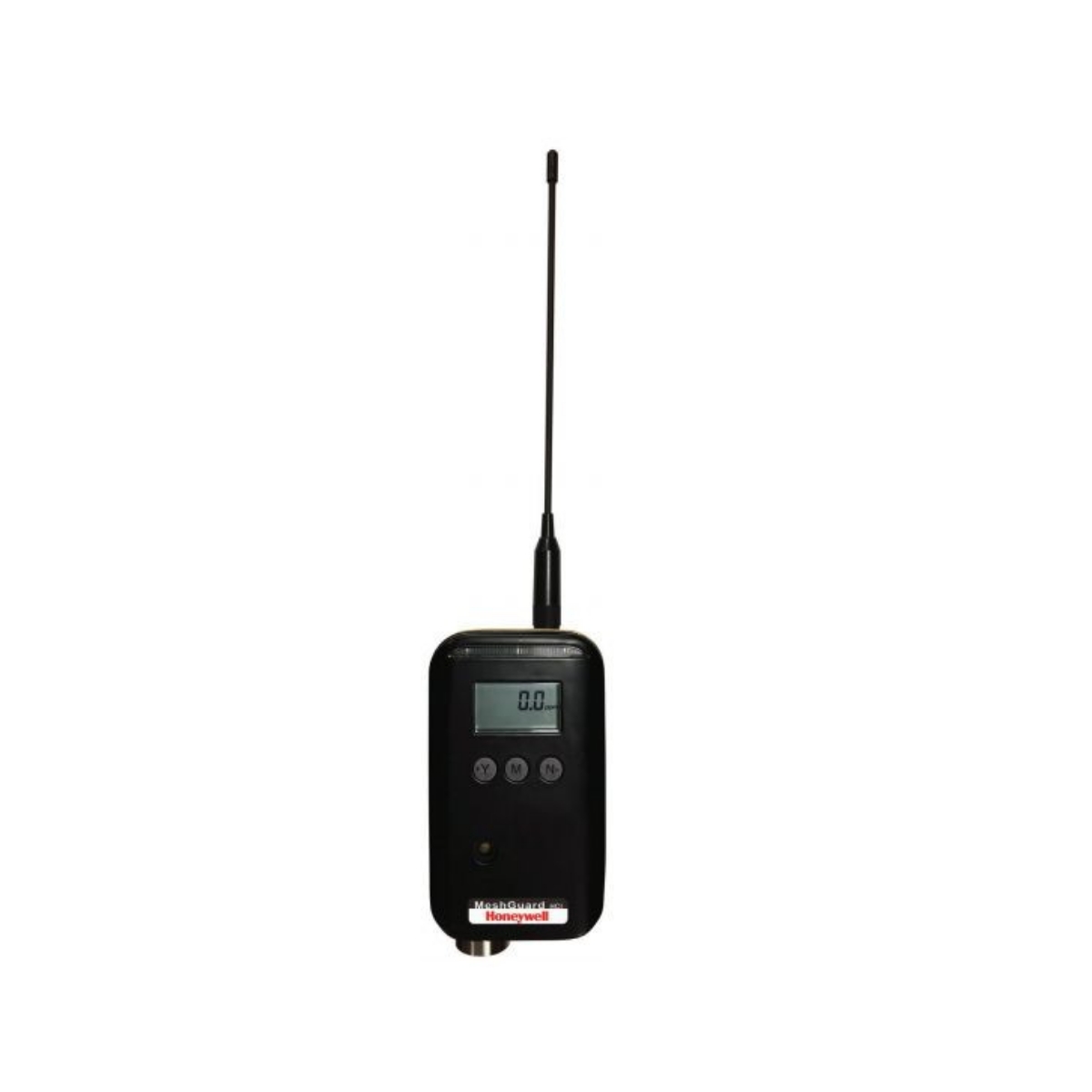
Honeywell Meshguard is a wireless, semi-fixed gas monitoring platform for hazardous temporary sites, combining mesh networking with rugged, autonomous detectors.
Honeywell Meshguard is a wireless, semi-fixed gas monitoring system for rapid deployment in demanding industrial and remote environments. It provides area and perimeter coverage for toxic, oxygen and combustible gas hazards using compact, intrinsically safe detectors connected via a self-forming mesh network. With stainless steel construction, wide environmental tolerance and flexible power options, MeshGuard supports temporary projects and changing layouts without hardwiring. Integrated alarms, clear local indication and centralised monitoring help safety teams maintain continuous visibility of gas risks across complex, hazardous sites.
AT A GLANCE
- Flexible wireless platform: Self-forming, self-healing mesh network delivers long-range, cable-free coverage for changing temporary work areas.
- Built for harsh, hazardous sites: Stainless steel, weather-resistant, intrinsically safe detectors support use in classified and corrosive environments.
- Extended, autonomous operation: Internal batteries, external PowerPaks and optional SolarPaks enable long runtimes and reduced site visits.
- Centralised visibility and control: Controllers and software aggregate data from multiple detectors for coordinated alarms and faster decisions.
For detailed technical data, consult the Specifications tab.
Overview of Honeywell Meshguard
Rapid, cable-free gas monitoring for temporary worksites
Honeywell Meshguard is designed for short- to medium-term area monitoring where speed of deployment, flexibility and coverage take priority over permanent infrastructure. Each compact, lightweight detector operates fully wirelessly from internal or external battery power, avoiding trenching, cabling and complex engineering work. Detectors can be positioned quickly around process units, tank farms, confined space entries and maintenance work zones, then removed and redeployed as projects move or shutdowns progress.
The system is particularly suited to plant turnarounds, drilling and production activities, marine and shipyard operations, tank farm work and other mobile or remote applications where conventional fixed gas detection is impractical or uneconomic.
Intelligent self-forming mesh network
An IEEE 802.15.4 self-forming, self-healing mesh network underpins the MeshGuard platform. Operating in the 2.4 GHz ISM band with 64-bit encryption, detectors automatically join the network and route data via the most reliable wireless path. This auto-network forming capability removes complex RF configuration and helps maintain communication even when equipment or structures move or are added.
Long line-of-sight wireless range between devices supports multi-hop networking, extending coverage over wide areas for perimeter or distributed grid monitoring. Mesh routers, remote EchoView displays and stainless steel accessories further enhance reach and visibility in congested or multi-level facilities, helping maintain a clear overview of site conditions.
Rugged, intrinsically safe design for harsh environments
MeshGuard detectors use stainless steel housing and components for high durability and corrosion resistance in harsh industrial and offshore settings. IP65 ingress protection guards against dust and water jets, while an integrated splash guard and optional rain guard help shield sensors in wet or exposed outdoor locations. Intrinsically safe design with hazardous-area approvals supports use in classified zones where flammable gases, vapours or combustible dusts may be present.
Key sensors operate across a wide temperature and humidity range, supporting deployment from cold, dry climates to hot, humid sites. Dedicated stainless steel MeshGuard versions are available for particularly corrosive or offshore environments, providing a consistent platform across diverse site conditions.
Flexible power for extended runtime and reduced site visits
Battery power gives MeshGuard its deployment agility and helps minimise maintenance overhead. Each detector can run on an internal disposable lithium D-cell, with optional external rechargeable PowerPaks to extend runtime for toxic, oxygen and combustible gas channels. Where round-the-clock operation is essential, an optional SolarPak kit supports 24/7 autonomous monitoring, reducing battery change intervals and technician call-outs.
This combination of internal, external and solar power options allows runtimes to be tailored to project duration and risk level, without adding temporary mains supplies or extra cabling that can complicate worksite logistics.
Accurate sensing and streamlined maintenance
MeshGuard supports a broad portfolio of electrochemical and infrared sensors for toxic, oxygen and combustible gas monitoring, enabling configuration for common hazards such as hydrogen sulphide, carbon monoxide, carbon dioxide, oxygen deficiency and flammables, as well as other specialised gases. Sensors are designed to deliver fine resolution and fast response times, helping detect changing gas conditions promptly for earlier intervention.
Field-replaceable sensors and consumables minimise downtime and simplify maintenance in remote or temporary locations. A straightforward two-point field calibration process, accessed via a three-key keypad and local display, supports quick onsite adjustment by a single technician. Combined with long runtime options, this helps reduce service windows and overall lifecycle costs.
Clear local alarming and status indication
In the field, MeshGuard provides clear local indication of hazardous conditions. Bright dual red LED indicators and a loud audible alarm are designed to be highly visible and audible in busy industrial environments, while an optional vibrating alarm offers an additional notification channel in high-noise areas. Bright red flashing alarms help draw attention from a distance during emergency conditions.
The large, customised LCD with backlight continuously presents real-time gas readings, alarm status, wireless link quality and battery information. User-adjustable high and low alarm thresholds, plus STEL and TWA functions in portable mode, support compliance with site safety policies and exposure limits.
Centralised monitoring, integration and scalability
Beyond individual detectors, Honeywell Meshguard scales into a site-wide area monitoring solution. Controllers such as the FMC-2000 and Touchpoint Plus Wireless can each support multiple MeshGuard detectors, providing a central point for alarm management and interface to wider safety systems. Integration with ProRAE Guardian software enables real-time viewing, logging and management of large instrument fleets over PC or Ethernet networks, with the capability to oversee hundreds of devices across a facility.
Centralised dashboards give safety teams a coherent view of distributed gas data, supporting faster incident response and better-informed decisions. Support for remote relay units and alarm devices, including RAEPoint units with alarm bars, extends alerts to beacons, sirens and control logic to align with existing emergency systems.
Kits, mounting options and lifecycle support
MeshGuard is available in Compliance Kits and Extension Kits that bundle detectors, controllers, mounting hardware, filters, calibration caps and other essential components for typical applications such as hydrogen sulphide, carbon monoxide and flammable gas monitoring. Rugged transport cases with pre-cut foam help protect equipment in transit and simplify redeployment between sites, with space for multiple detectors and a controller.
A wide range of approved accessories, including PowerPaks, SolarPaks, antennas, mounting boards, stainless steel brackets, pole mounts and strong magnetic mounts, allows a single detector platform to be adapted to many locations without custom fabrication. Readily available consumables and spares, such as filters, O-rings, covers, batteries and antennas, support long-term ownership and consistent performance across the lifecycle of temporary and semi-permanent monitoring campaigns.
Specifications
| Visual Alarm | 2 super-bright red LEDs |
| Audible Alarm | 90dB @ 30cm |
| Calibration | Two-point field calibration |
| RF Frequency | 2.4GHz ISM Band, IEEE 802.15.4 standard compliant |
| Operating Range | 300 metres / 985 feet (line of sight) |
| Keypad | Three operation and programming keys |
| Display | Customised LCD (1" × 1.5" / 72mm × 108mm) with backlight |
| Power Supply | Disposable Lithium Battery, +3.6V (optional rechargeable external battery for extended run time) |
| Operating Time | Toxic Gas Sensors: Up to 6 months on internal battery (up to 2 years on external) Flammable Gas Sensor: Up to 21 days on external PowerPak battery LEL IR Gas Sensor: Up to 2 months on internal battery** (up to 1 year on external) |
| IP Rating | IP-65 |
| Operating Temperature | -40°C to +50°C (-40°F to 122°F) for LEL, LEL IR, CO and H2S sensors. Other sensors: -20°C to +50°C (-4°F to 122°F) |
| Humidity | 5% to 95% relative humidity, non-condensing |
| Size | 26.5cm × 9.5cm × 5.5cm (10.5" L × 3.7" W × 2.1" H) |
| Weight | 0.6kg (1.3 lbs) |
| Wireless Frequency | ISM license free band, IEEE 802.15.4 2.4 GHz |
| Wireless Approvals | PCC Part 15, CE R&TTE, Others*** |
| Radio Module | Supports RM2400A |
| Certifications | US and Canada: Class I, Division 1, Groups A, B, C, D, T4 |
| Europe: ATEX IM1/II 1G Ex ia I/IIC T4 | |
| Customs Union: PO Ex ia I Ma/0Ex ia IIC T4 Ga / PB Ex d ia I Mb/1Ex d ia IIC T4 Gb | |
| Contact manufacturer for country-specific certification | |
| *Specifications are subject to change. **MeshGuard LEL IR units operating in temperatures below -20°C (-4°F) may require a PowerPak external battery for extended runtimes. ***Contact Honeywell for country-specific wireless approvals and certificates. |
Gases
| Gas | Range | Resolution |
| H2S | 0 to 100 ppm | 0.1 ppm |
| H2S | 0 to 1000 ppm | 1 ppm |
| LEL / LEL IR | 0 to 100% LEL | 1% LEL |
| CO | 0 to 2000 ppm | 1 ppm |
| CO2 IR | 0 to 50% Vol 0 to 100% Vol |
0.01% Vol 0.1% Vol |
| O2 | 0 to 25% Vol | 0.1% Vol |
| NH3 | 0 to 100 ppm | 1 ppm |
| Cl2 | 0 to 10 ppm | 0.1 ppm |
| SO2 | 0 to 20 ppm 0 to 100 ppm |
0.1 ppm 1 ppm |
| HCN | 0 - 50 ppm | 0.5 ppm |
| NO | 0 - 250 ppm | 0.5 ppm |
| PH3 | 0 - 20 ppm | 0.1 ppm |
| HCl | 0 - 15 ppm | 1 ppm |
| ETO-A | 0 - 100 ppm | 1 ppm |
| ETO-B | 0 - 10 ppm | 0.1 ppm |
| ETO-C | 0 - 500 ppm | 10 ppm |
| NO2 | 0 - 20 ppm | 0.1 ppm |
| HF | 0 - 10 ppm | 0.1 ppm |
Documents