


Sales and Site Survey - liz@ribblegd.co.uk
Description
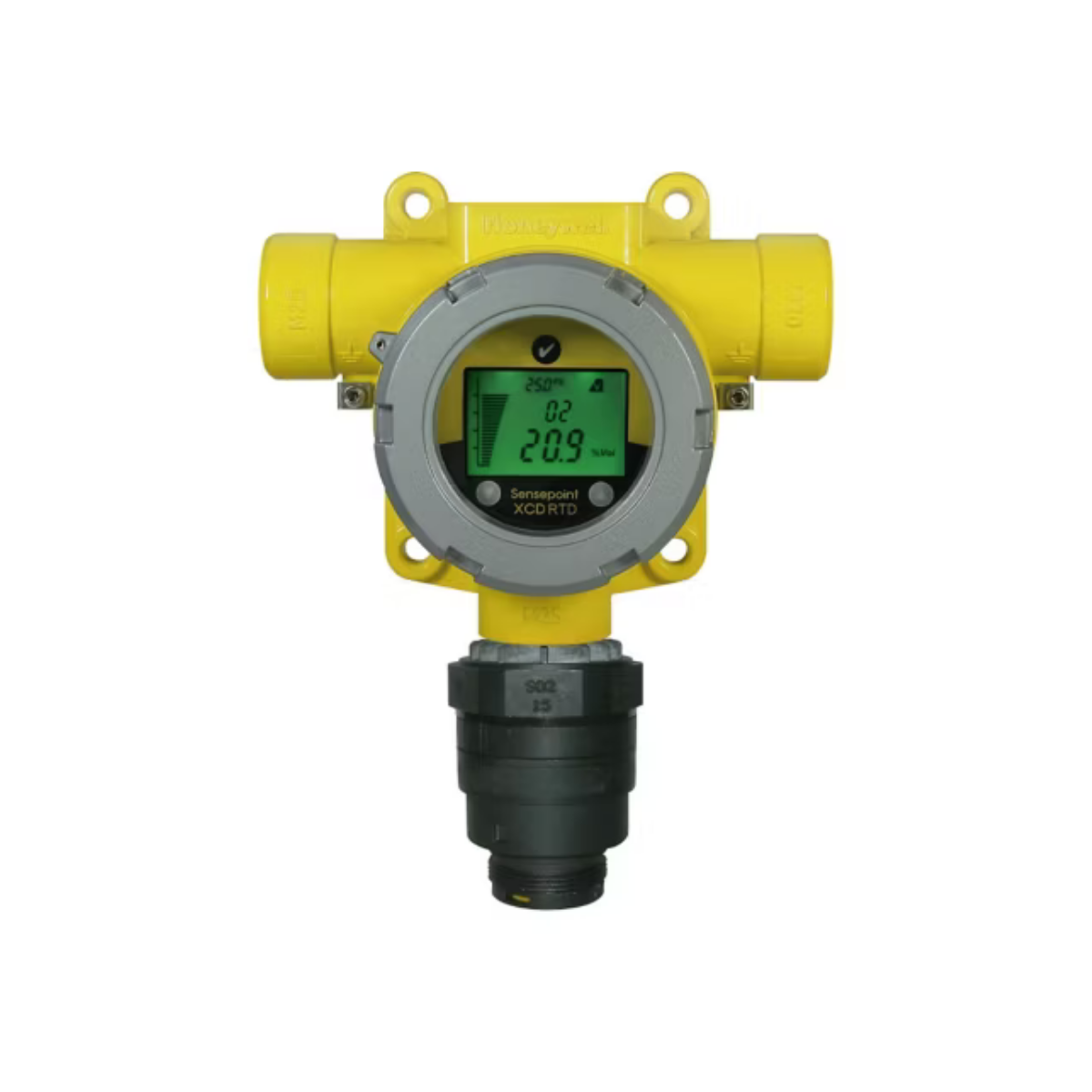
Honeywell Sensepoint XCD RTD is a remote toxic and oxygen gas detector for Class I, Div. 2 areas with clear tri‑colour status.
Honeywell Sensepoint XCD RTD is a remote toxic and oxygen gas detector for industrial areas classified due to flammable gases or vapours. Its separated transmitter and sensing head allow the sensor to be positioned at the optimal gas accumulation point while keeping the display and controls at eye level. A large tri‑colour status display, onboard diagnostics and non‑intrusive one‑person servicing support safer operation, faster decision-making and reduced maintenance overheads across complex facilities.
AT A GLANCE
- Remote toxic and oxygen monitoring: Sensor mounted up to 30 m from the transmitter for hard-to-access or hazardous locations.
- Instant visual status: Large tri‑colour “traffic light” display and clear indicators support quick safety checks and audits.
- Non-intrusive, one-person servicing: Magnetic switches and plug‑in sensor modules cut downtime, permits and specialist call-outs.
- Flexible integration platform: Selectable sink/source 4–20 mA and optional Modbus RS485 in rugged IP66/67 enclosures with broad mounting and accessory options.
For detailed technical data, consult the Specifications tab.
Overview of Honeywell Sensepoint XCD RTD
Remote Gas Detection at the Point of Risk
Honeywell Sensepoint XCD RTD is designed for continuous monitoring of toxic and oxygen hazards in Class I, Div. 2 hazardous areas, often classified because of surrounding flammable gases or vapours. Its remote architecture allows the sensing head to be installed up to 100 ft (30 m) from the transmitter, so the sensor can be positioned exactly where gas is most likely to accumulate – high, low, concealed, within ducts or outdoors – while the transmitter remains accessible at eye level.
This approach expands gas detection coverage without increasing exposure of personnel to difficult or dangerous locations. It reduces the need for ladders, scaffolding or lifts and supports safer working practices across oil and gas, power generation, utilities, wastewater, manufacturing, coal processing and food and beverage facilities.
Clear Visual Status for Faster Decisions
A prominent tri‑colour “traffic light” display provides immediate status indication from a distance, helping personnel quickly assess whether an area is in normal, warning or alarm condition. Additional status indicators and clear text feedback communicate fault and maintenance states, so device condition is understood at a glance.
This combination of visual cues and onboard diagnostics shortens inspection rounds, simplifies safety audits and reduces the likelihood of misinterpretation or human error, particularly for mixed-experience maintenance teams.
Non-Intrusive Maintenance with Reduced Downtime
The detector is engineered for one-person servicing using non‑intrusive magnetic switches, allowing configuration and calibration without opening the enclosure. This supports safer work in potentially explosive atmospheres, helping to minimise permit requirements, exposure time and disruption to operations.
A removable, plug‑in sensor module enables fast replacement, limiting downtime during sensor changes or refurbishment. The system also supports remote functional checks and audits from the transmitter location, avoiding direct access to the sensing head in elevated or restricted areas. An auto‑inhibit function during maintenance helps prevent false alarms and nuisance trips while work is carried out.
Using a common transmitter platform across the Sensepoint family further simplifies training and spare parts management, reducing complexity for maintenance and stores teams.
Wide Gas Coverage on a Single Platform
Sensepoint XCD RTD supports a broad range of Honeywell Sensepoint toxic and oxygen sensors, allowing detection of oxygen, common toxic gases and other industrial targets on a shared hardware platform. This enables standardisation of gas detection across multiple processes and plant areas, while addressing toxicity, asphyxiation and oxygen enrichment risks within the same system architecture.
Factory‑matched transmitter and sensor combinations help ensure correct gas types and measuring ranges for each application, streamlining specification and procurement. Compatibility with Honeywell maintenance and service programmes supports long-term operational performance.
Rugged Design for Harsh, Hazardous Environments
The detector is built for potentially explosive atmospheres and demanding industrial conditions. IP66/67 enclosures protect against dust and water ingress, making the unit suitable for indoor plant rooms as well as exposed outdoor locations. Select models provide additional corrosion resistance for harsh or coastal environments.
Epoxy-painted aluminium alloy and 316 stainless steel explosion-proof enclosure options allow alignment with corrosion, hygiene and mechanical robustness requirements. Certain transmitter configurations are supplied with junction boxes, helping design teams match installation practice to local codes. Multiple regional approvals and certificates support deployment across global facilities.
Installation and Integration for Modern Control Systems
Sensepoint XCD RTD offers flexible installation using mounting plates, brackets and conduit options for wall, pole, duct or fully remote sensor arrangements. Multiple conduit and cable entry sizes, including common metric and NPT threads, support regional wiring practices and existing site infrastructure.
An extensive accessory range – including calibration cups, collecting cones, duct kits, sunshades, deluge protection and junction boxes – enables one detector platform to cover varied applications, from outdoor pipe racks to indoor process areas and ventilation ducts. This reduces the number of hardware variants required across a site.
The transmitter provides a selectable sink or source 4–20 mA output for straightforward connection to control and safety systems. Models are available with 4–20 mA analogue only, or 4–20 mA plus Modbus RS485 for digital communication into building, plant or safety controllers and supervisory systems.
Safety Functions and System Response
Three configurable alarm levels and integral 5 A relays allow direct control of audible and visual alarms, ventilation systems, process shutdowns or other safety functions. Low and high alarm settings can be adjusted to meet site-specific risk assessments and operating envelopes, helping integrate the detector into wider emergency response strategies.
Combined with three‑colour status indication and strategic remote sensor placement, these features help ensure that hazardous conditions are detected early and acted on decisively, even in large or complex layouts.
Platform Standardisation and Lower Total Cost of Ownership
Sensepoint XCD RTD supports lower lifecycle cost through its low power consumption, common transmitter platform and serviceable design. Non‑intrusive one-person maintenance, quick plug‑in sensor replacement and compatibility with general maintenance technician skill levels all shorten service windows and reduce external call-outs.
Standardising on a single detector platform for toxic and oxygen monitoring decreases training requirements, simplifies spare parts holdings and eases integration into typical DC power supplies and control architectures. As a result, operators can extend gas protection coverage while managing capital expenditure and ongoing operating costs more effectively.
Documents