We Deliver Worldwide
 Call +44 (0) 1200 445 804
 Email info@ribble-enviro.co.uk





 ShipServ
 6-Month
 Fast Shipping
 Contact Us
Description
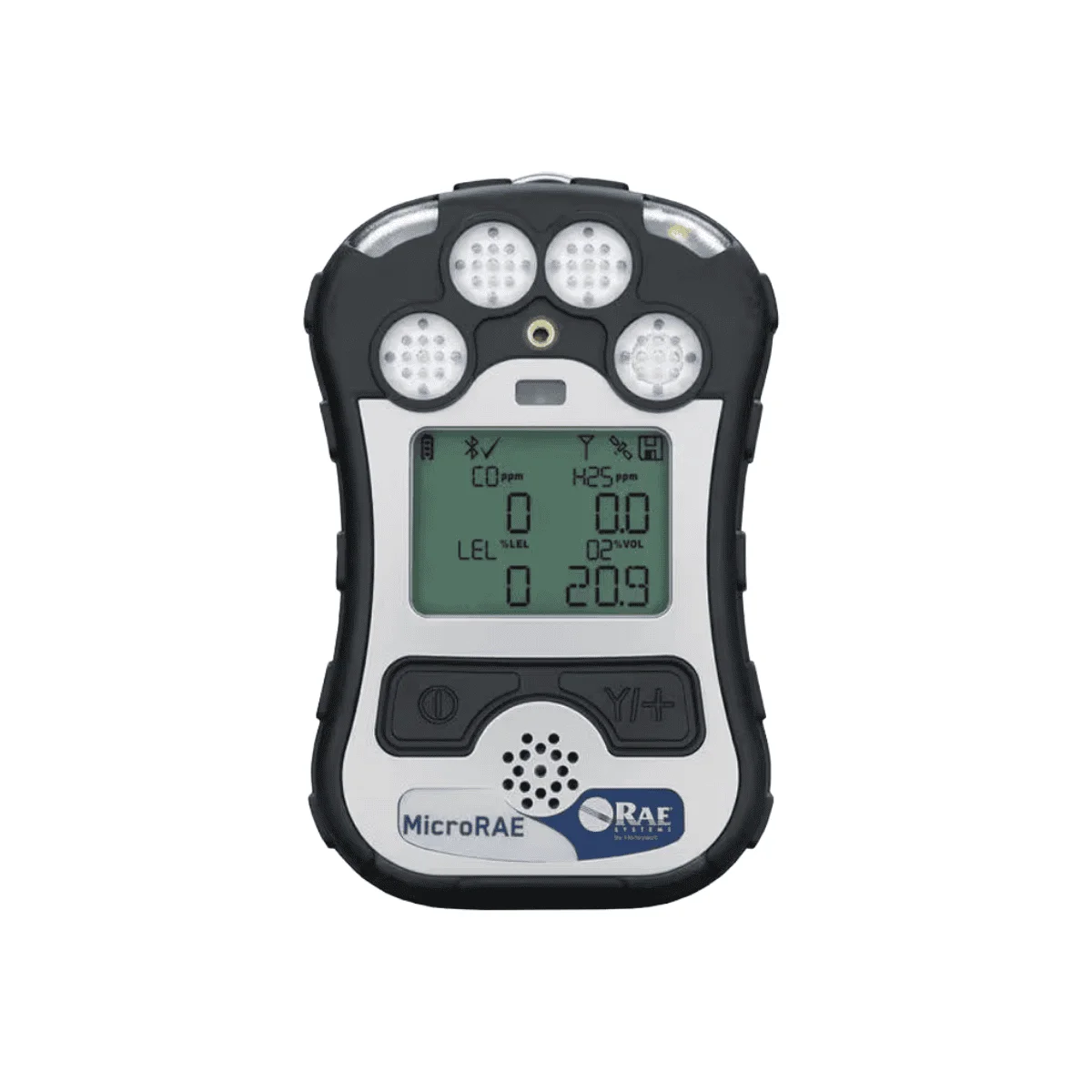
RAE Systems MicroRAE is a wireless four-gas personal monitor for hazardous industrial areas, delivering connected visibility and lone-worker protection.
RAE Systems MicroRAE is a compact wireless four-gas diffusion monitor for personal protection in demanding industrial and emergency response environments. It continuously measures oxygen, combustible, and key toxic gas hazards while transmitting real-time readings, alarms, and location data to remote systems. Multiple wireless options, integrated Bluetooth, and optional GPS support connected worker strategies and faster incident response. Rugged, lightweight construction, strong multi-channel alarms, and long-life rechargeable power make it suitable for all-day wear, while streamlined testing, calibration, and datalogging help strengthen compliance and fleet management.
AT A GLANCE
- Connected four-gas personal monitoring: Simultaneously tracks oxygen, combustible, and toxic gas hazards with optional additional toxic sensing.
- Flexible wireless integration: Mesh, Wi‑Fi, NB‑IoT/sub‑GHz Mesh and Bluetooth connectivity link detectors to Honeywell ConneXt and wider safety systems.
- Rugged, wearable design: Lightweight, IP67-rated housing and robust clip options support comfortable all-day use in harsh environments.
- Efficient testing and compliance: Fast bump tests, AutoRAE 2 compatibility and extended datalogging support regulatory reporting and fleet oversight.
For detailed technical data, consult the Specifications tab.
Overview of RAE Systems MicroRAE
Connected four-gas monitoring for real-time situational awareness
RAE Systems MicroRAE is engineered to provide continuous, real-time visibility of critical gas hazards for personnel working in hazardous and hard-to-reach areas. This wireless four-gas diffusion monitor simultaneously measures oxygen, combustible gases, and key toxic gases, with optional hydrogen cyanide sensing where required. Real-time gas concentration readings, alarm status, instrument health, and location data are transmitted via advanced wireless technology so supervisors can see current exposure, identify emerging threats, and coordinate response based on live information.
Multiple wireless connectivity options – including Mesh, Wi‑Fi, NB‑IoT / sub‑GHz Mesh and Bluetooth Low Energy – support a wide range of network architectures, from local plant coverage to broader connected worker platforms. Compatibility with the Honeywell ConneXt family and Safety Communicator enables the MicroRAE to fit into scalable, connected safety ecosystems for single sites or multi-location fleets.
Enhanced lone-worker protection and incident response
The MicroRAE supports lone-worker and high-risk tasks with integrated safety features that extend visibility beyond line of sight. The Man Down Alarm detects lack of motion or possible worker distress and can automatically send real-time notifications to remote supervisors. A dedicated Panic function allows workers to trigger immediate escalation, helping ensure that critical events are not missed in noisy or complex environments.
An optional GPS module adds precise location information to gas readings and alarm events, improving the speed and accuracy of rescue and enabling more informed decision-making during incidents. Continuous wireless status and connectivity alarms highlight any loss of communication so that safety teams know when an individual detector is no longer visible to the network.
Robust, lightweight design for demanding environments
Despite its capabilities, the MicroRAE remains compact and lightweight, supporting comfortable all-day wear using the stainless-steel alligator clip or optional wrist wrap. Its rugged, concussion-proof housing and IP67 dust- and water-resistant rating support reliable operation in harsh industrial plants, outdoor sites, and emergency response scenarios.
A wide operating temperature range and high humidity tolerance help the detector maintain performance across varied climates and applications, from oil and gas and petrochemical facilities to utilities, wastewater, telecommunications, construction, and firefighting. Global hazardous area approvals and certifications support consistent deployment across regions, simplifying standardisation for multinational operators.
High-visibility alarms and clear status information
The MicroRAE combines multiple alarm channels to ensure warnings are recognised quickly in noisy and visually cluttered worksites. A high-intensity, multi-tone audible alarm, bright flashing LEDs, and strong vibration provide unmistakable local alerts. On-screen alarm messages present clear, contextual information at the point of risk, while wireless notifications propagate those alarms to supervisors, control rooms, or connected platforms.
Alarm behaviour can be configured for latching, non-latching, and manual override modes, enabling alignment with site policies and procedures. Additional low-battery, wireless connectivity, and Man Down status indicators further support reliable protection by drawing attention to conditions that could compromise monitoring.
Intuitive interface and actionable exposure data
The MicroRAE is designed for straightforward operation in the field. A monochrome graphic display with a large viewing area and dual-colour backlight maintains readability in low light, high glare, and confined spaces. Real-time readings are presented alongside short-term exposure limit (STEL), time-weighted average (TWA), peak, and minimum values to support exposure tracking and regulatory compliance.
A simple two-button keypad allows intuitive navigation, even with gloved hands, helping reduce training demands for permanent staff and contractors. On-screen indicators show wireless and GPS status, reception quality, Man Down status, and policy enforcement / IntelliFlash compliance cues, giving at-a-glance confirmation that the detector is operating within defined safety parameters.
Efficient maintenance, calibration, and datalogging
The MicroRAE is designed to minimise downtime and simplify fleet maintenance. Short bump test and calibration times help keep detectors operational, while two-point calibration can be carried out manually or automated using the AutoRAE 2 Automatic Test and Calibration System. External AutoRAE 2 systems enable centralised, fully automated bump testing and calibration for large instrument fleets, reducing manual intervention and helping standardise procedures across sites.
A long-lasting rechargeable Li-ion battery provides typical runtimes suitable for full shifts, including with wireless functionality enabled, reducing the need for mid-shift charging. Continuous datalogging can store months of readings for four sensors at user-selectable intervals, creating a detailed audit trail that supports incident investigations, regulatory reporting, and continuous improvement programmes. Data can be transferred via PC through the travel/charging cradle, which also supports firmware updates.
Flexible configuration, fleet management, and ecosystem fit
The MicroRAE platform supports multiple sensor configurations, including catalytic bead LEL and electrochemical sensors for carbon monoxide, hydrogen sulphide, hydrogen cyanide, and oxygen, allowing safety teams to match detectors to site-specific hazards. Filtered LEL sensor options help inhibit poisoning from contaminants such as hydrogen sulphide and silicones, extending sensor life and supporting consistent performance.
Device management and oversight are enhanced through Honeywell SafetySuite software, which supports configuration management, data handling, and policy enforcement across distributed fleets. The detector is available as monitor-only units or as part of complete kits, with a broad range of accessories – including gang chargers, travel and truck-mount chargers, auxiliary filters, hand pump and confined space kits, and service kits – enabling a single platform to cover diverse applications while simplifying spares and training.
With ISM licence-free wireless operation over sub‑GHz Mesh and 2.4 GHz Wi‑Fi bands, integrated Bluetooth, typical wireless ranges suitable for plant-wide coverage, and options for integration with compatible radio systems and connected worker platforms, the MicroRAE fits readily into existing safety architectures. It is suited to high‑risk operational scenarios such as emergency response, fracking, plant shutdowns and turnarounds, residential calls, urban search and rescue, and fire overhaul, helping protect workers, facilities, and the environment through continuous, connected visibility.